A Cup of Tea and a Sing-Along
Many years ago I discovered a small dessert bowl in my mother’s collection which I had no memory of her using. It appeared to be from a large antique dinner setting. My whimsical imagination led me to believe that it was all that remained of a set that had been given to my grandparents as a wedding gift in the 1930s.
My mum and uncle have no childhood recollection of any such set but I’ve decided to “not let the truth get in the way of a good story”.
From the day I discovered the bowl until today, I have endeavoured to collect the remaining pieces of the set. However, the collection process has been a little like playing Whac-A-Mole. Just when you think there couldn’t possibly be another piece, a slightly different bowl or platter etc shows up. It seems to be a set that had a never-ending number of pieces. If one were to use it in its entirety, one would need a seperate table for the actual consumption of food. I would love to travel back in time to find out exactly what each piece would have been used for.
The collection is named “Lilac Time” and was produced by J and G Meakin, an English pottery company founded in 1851 and based in Hanley, Stoke-on-Trent. The pattern was produced for domestic and export markets and was made of ironstone china, an affordable alternative to the more delicate porcelain. Ironically, ironstone contains no iron. (Apologies for the pun!)
There is some confusion regarding the history of the design.
One version of the story is that it was first created in the 1930s and was inspired by the film “Lilac Time” which starred Colleen Moore and Gary Cooper. Its plot centred around a French farm girl’s search for her lover, a British fighter pilot whose plane had been shot down. She journeys to Paris in the hope of finding him in one of the hospitals and reunites with him in a lilac garden.
Looking at the attire of the people in the illustrations on the crockery set however, I’m inclined to believe another version of its history.
It instead may have been produced in the 1920s and inspired by the 1917 Viennese operetta, “Lilac Time”, which was a fanciful biographical story of Franz Schubert’s unrequited love for his pupil, Mitzi. The operetta, which features Schubert’s music, was inspired by the novel “Schwammerl”, written by Rudolf Hans Bartsch.
Now, a lifetime ago, I was a classical singer and performed many of Schubert’s songs. So you can imagine my delight in discovering that my Grandma’s seemingly insignificant bowl was inspired by the music and (not-so-true) story of one of my favourite composers. Not only that, my research led me down a rabbit hole to a lovely recording of one of my favourite Australian opera singers - and good friend of my dad - June Bronhill, singing a duet from the original operetta with John Cameron.
Here is a link to the recording for those who are interested to hear these glorious voices of times gone by.
https://www.youtube.com/watch?v=SiNwRnus-ik&list=RDSiNwRnus-ik&start_radio=1
I find it fascinating how often the arts merge throughout history, and how often facets of my ancestry reappear in my own life.
I think it’s time to pour myself an iced coffee in my 100 year old cup and quietly sing along with its inspiration.
Nikki
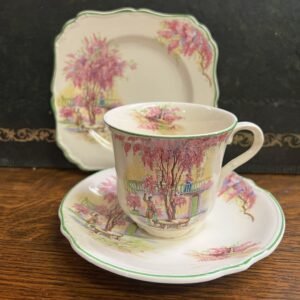
Now all I need is the elusive coffee and tea pots to fully experience a cuppa of times gone by…